 Milli Modificomillimod.com

The 964,
Evolved.
The Approach
The premise of this car is simple: continue the 964's development. Most builds of this era look backward, to the long-hood cars or the race paddock. This one looks forward, down the road the 964's engineers were on when production ended in 1994.
The conviction has an origin. It formed behind the wheel of a friend's 964 — a car conceived and executed with unusual care, modified subtly and everywhere at once. That drive revealed something no production car offers: how a handful of considered changes to an already stellar package can transform it into something the factory never sold. The experience stayed, and it ultimately drove the commissioning of this project.
The 964 was the last major evolution of the original 911 — coil-sprung, better cooled, still hand-assembled — and its design holds more development than it ever received. This build supplies that development: thirty years of Porsche and aftermarket engineering that did not exist in 1989, applied to the car's own architecture.
Four working rules governed every selection.
The front bumper is smoothed. The mirrors are the aero units from later 911s. Both changes serve function first; both also resolve details the production car left unresolved.
Each component is the current state of the art applied to the 964's own architecture. The Swindon 24-valve heads, the Arrow billet crankshaft, the titanium rods, the MoTeC M130, and the Tractive dampers all fall in this category.
The sunroof is deleted. The factory air-conditioning compressor and heat plumbing are deleted and replaced with Classic Retrofit's electric system. The brake package was selected for low unsprung mass and sized to clear 17-inch wheels — the diameter family the car was designed around — rather than for visual effect. And the weight that stays gets repositioned: a rear-engined car improves with every pound moved toward the nose, so the mass this build adds or relocates goes forward deliberately.
The airflow decision governs the rest. The crank geometry serves the heads. The exhaust follows the ports. The cooling and tinware follow the exhaust. Decisions were sequenced so that no component fights another.
The result is one owner's considered answer to a specific question: the best street 964 he can define — and, in his estimation, the best 911. The chapters that follow support that position with the record.
Contents
| Chapter | Focus |
|---|---|
| 01 · The Motor | 4.0 Liters · 24 Valves |
| 02 · Induction & Management | Jenvey eITBs · MoTeC M130 · GT3-Style Open Center Plenum |
| 03 · The Exhaust | Custom Patrick Motorsports Flow Package |
| 04 · Chassis | Tractive Damping · RS/EVO Uprights · Brakes |
| 05 · Subtraction & Redistribution | Deletions · Mass Moved Forward · The Engine Bay |
| 06 · Body & Color | Sterling Mist · Smoothed Bumper · Aero Mirrors |
| 07 · Wheels | 18-Inch Fikse In The Fuchs Pattern |
| 08 · Interior | Tuthill Tombstone Shells |
| § · Where It Started, Where It Lands | The Numbers, Concluded |
| Companion Volume | The Financial Record — Bound Separately |
The Motor
Porsche wanted more from this engine. When the company designed the M64 for the 964, its engineers considered four-valve cylinder heads and abandoned them — the thermal loads were beyond what air cooling and 1989 casting technology could manage, a problem that persisted through the 993. Dual ignition was the workaround: a two-valve chamber cannot center its spark plug, and on a bore this large the flame front needs real time to cross it — so Porsche fired the mixture from two plugs at once, buying back compression and emissions compliance the chamber geometry had cost. And the company that made that compromise was running out of money. Porsche entered the early 1990s in a financial crisis that nearly ended in bankruptcy; the 964 was engineered under constraints of cost, tooling, and time that its own designers would not have chosen.
Porsche eventually built the four-valve flat-six it wanted. It arrived water-cooled: the Mezger engine of the GT3 era, the architectural descendant of the air-cooled block, which finished its run in 2011 as the 997 GT3 RS 4.0 — four liters, four valves per cylinder, 500 horsepower at 8,250 rpm. That engine is the closest thing to a factory answer for what this build attempts. The difference is that this one stays air-cooled. Modern materials and machining resolve the thermal problem that forced the original compromise: the Swindon heads are cast from aerospace-grade A356 aluminum and CNC-machined to Formula 1 tolerance standards — precision that a near-bankrupt Porsche could not put into a production engine. The result is a 4.0-liter, 24-valve flat-six with the specification of the last Mezger and the character of the original 911.
The goal was purposeful power: an engine that runs cooler because it breathes better, revs freely because its valvetrain is light, and delivers what Porsche could not deliver in period without the shift to water cooling.
The work began with measurement. The engine came fully apart under a 60-hour teardown: every component cleaned, measured to specification, and magnafluxed before any parts money was spent.
Four valves per cylinder replace two. Valve area increases, the spark plug moves to the center of the chamber, and the twin-plug workaround becomes unnecessary. The materials are where the modern era shows. The castings are A356 aluminum — an aerospace-grade alloy chosen for its strength-to-weight and thermal conductivity — cast in the UK and CNC-machined, heads and cam chests both, in the same Swindon facility that builds British Touring Car Championship engines. All twenty-four valves are titanium, intake and exhaust — 40mm intakes and 33mm exhausts with up to 11.5mm of lift — each carrying its own springs, caps, collets, and shims from the kit, actuated by finger followers on twin overhead camshafts. The result sheds 7.7 lbs against the original heads while rejecting heat more effectively — the four-valve air-cooled head Porsche studied and shelved, built with the materials that make it work. This is the largest single change in the build, and it is among the first of these engines destined for an American road car. The plenum, tinware, exhaust, and cooling designs all proceed from it.
EN40B is a British nitriding steel — a chromium-molybdenum alloy developed for crankshafts and high-load shafting. After machining, the finished crank is nitrided: nitrogen diffuses into the surface at low temperature, casehardening the journals to extreme wear resistance while the core stays tough and fatigue-resistant. It is the steel of choice for billet racing cranks, and Arrow machines this one from a solid billet of it to the GT3 RS stroke of 80.4mm — the geometry of the last Mezger engine, cut new. It is lighter than the factory GT3 RS crank of the same dimensions, and stiffer than the forging it replaces.
Titanium rods and lightweight valvetrain parts reduce reciprocating mass — together with the billet crank and Capricorn pistons, the rotating assembly sheds about 6 lbs. The engine revs faster and its bearings carry less load at high rpm. Swindon matches the rods, pistons, and crank as one validated set.
The pistons come from Capricorn. The company began by machining cylinder liners and engine blocks for Formula 1, expanded into high-tech forged pistons in the late 1990s, and has supplied components for the Porsche 919 Hybrid LMP1 program, Peugeot's Le Mans prototypes, and works rally cars. Its Porsche catalog runs from forged air-cooled barrels to complete four-cam Carrera engines for the 904. For this build, the 102.7mm set is designed around the 24-valve chamber: crowns cut for the four-valve geometry and the compression the heads allow, forged for strength at the target rpm, running in barrels with Capricorn's in-house nickel-ceramic bore coating — the modern successor to the Nikasil surface Porsche raced on.
Induction & Management
The factory heads held the engine back for two reasons. The M64's two large valves per cylinder limited total valve area, which restricted the air entering each combustion cycle. Large valves also demanded heavy springs, and heavy springs stressed the rockers and capped the rpm. Every air-cooled 911 lived inside those two limits.
The two-valve limit is physical, and no amount of lightening escapes it. A single intake valve can only grow so large before the chamber runs out of room, so a two-valve 4.0 — however exotic its valvetrain — breathes through the same restricted window. Four valves change this: each valve is materially lighter, and together their perimeters expose far more of the cylinder to the engine's pumping capacity. The Swindon heads apply exactly this. Four smaller titanium valves per cylinder open more total area than two large ones: in Swindon's testing, peak inlet flow rises about 40 percent over a standard 993 head and exhaust flow about 66 percent. The scale of that matters: Porsche's own step from the 964 to the 993 — better heads, better breathing, same two-valve architecture — was worth nearly 40 horsepower. These flow numbers measure against the improved 993 head, so the distance from this car's original engine is greater still. Smaller valves are lighter, which allows lighter springs, which frees the valvetrain — the head kit is engineered for engine speeds up to 12,000 rpm, and it weighs 7.7 lbs less than the heads it replaces. Twin overhead camshafts and finger followers replace the rocker arrangement entirely.
This build will not chase that 12,000 number. The 4.0-liter bottom end trades some of the rev ceiling for displacement and torque — comparable 24-valve four-liter builds make on the order of 430 horsepower — and the target redline is 8,500 to 9,000 rpm, settled on the dyno by how she behaves. What the headroom buys on a street car is character: an engine that pulls cleanly past the point where every factory air-cooled 911 has already gone breathless, with a valvetrain working easily at engine speeds far beyond the original's limit.
Heads that flow this much need induction that keeps up. One throttle per cylinder puts the airflow control an inch from the port, so response is immediate at any rpm. Electronic actuation hands the throttle map to the ECU: gentle tip-in for traffic, full authority on a back road, precise idle for cold mornings. A mechanical-injection path was studied in full before the electronic one was selected for street manners; the study remains in the record.
An engine with new heads, new cams, new induction, and a new redline has no map anyone has written. The M130 exists for exactly this case: it samples the engine continuously, controls fuel, spark, and throttle together, and logs everything so each dyno session builds on the last. The behavior target is set by the hardware and delivered by the calibration — cold starts like a modern car, docile at 2,000 rpm, and clean pull past 6,000 rpm that no production 964 delivered.
A Patrick Motorsports GT3-style plenum favors mid-range and keeps the induction quiet under the decklid — and in carbon it saves nearly 6 lbs over its aluminum equivalent. Open Jenvey × Swindon velocity stacks favor peak output and let the intake be heard. The choice waits for dyno data.
Together these three systems form one loop: the heads set what the engine can breathe, the throttle bodies control it cylinder by cylinder, and the M130 decides — thousands of times a second — exactly how much of it the engine gets.
The Exhaust
No catalog exhaust fits a 24-valve air-cooled flat-six. The port angles and exhaust energy differ from any production 964, so the system will be fabricated — a custom Patrick Motorsports exhaust, designed as a complete flow package and built in-house to the assembled engine. The design draws on James Patrick's forty-plus years with these engines. The fabrication talent exists inside his shop, and outside advisors check the work: Cargraphic's GT Sport is the known baseline, and Reef Exhausts consults from England with direct Swindon-head experience from the Tuthill 911K system.
The brief has four requirements. Equal-length headers, so every cylinder sees the same scavenging and the M130 tunes one engine rather than six. Exceptional sound — present, not obnoxious. Joints and flanges that respect the machining tolerances of the Swindon heads. And effective thermal management, because on an air-cooled engine the exhaust carries a large share of the cooling work.
The material will likely be stainless steel rather than Inconel, and the choice is about character. Inconel walls run thinner and lighter, and they sound like a race car. Stainless is slightly thicker and heavier, and its note is rounder and more soulful — the right soundtrack for this car. It is one of the few places the build accepts weight for the experience. Even so, the complete system will remove 37 lbs from the rear of the car against the factory exhaust.
Fabrication follows the head installation; the headers will be built against the assembled engine.
Chassis
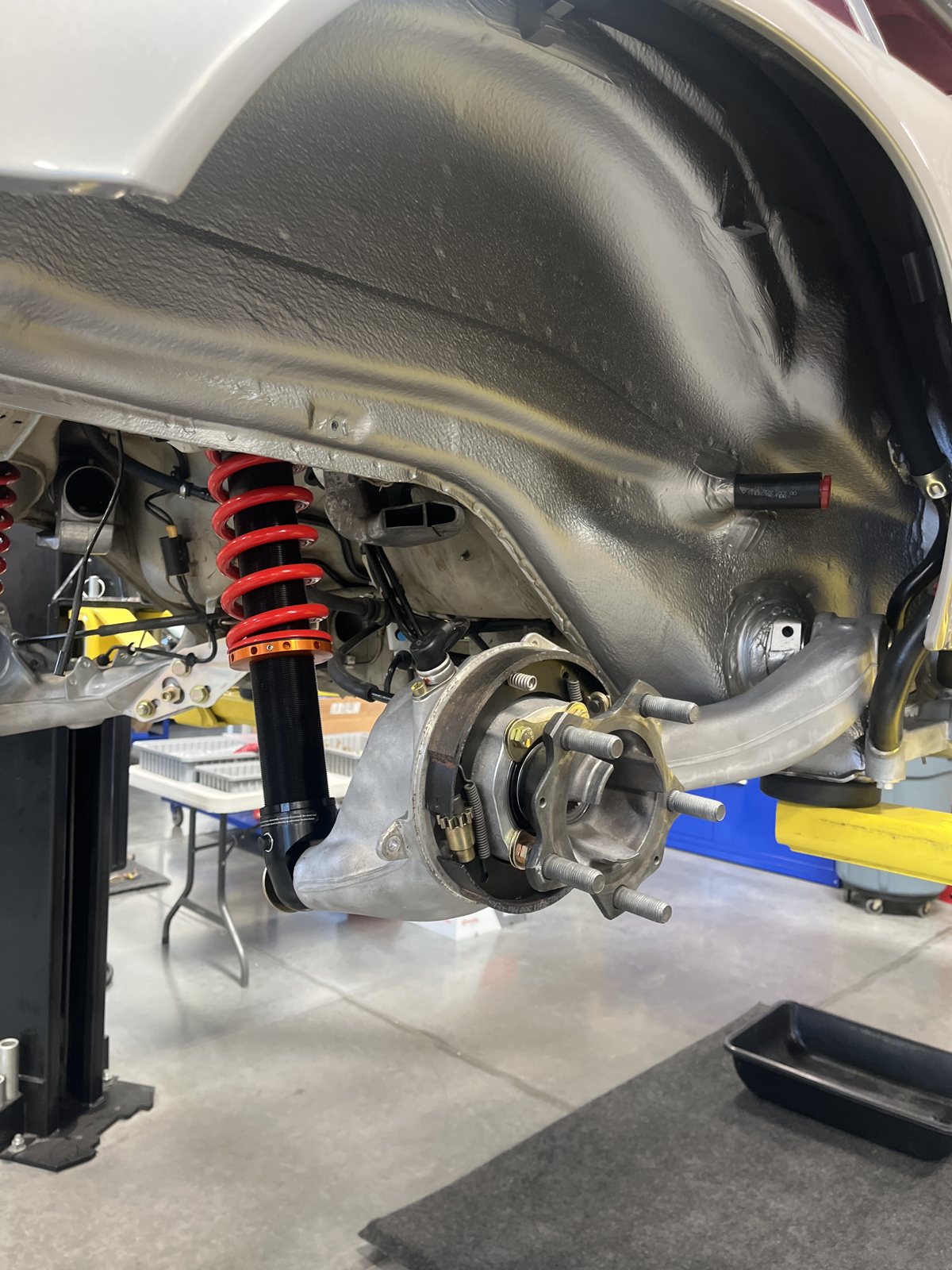
The 964 shipped with one damper calibration for all roads. TracTive is the Dutch electronic-suspension house whose systems run in racing, street, and off-road applications — and in the best of the modern 911 restomods: Kalmar, Schmidt, and Theon all build on it, and RUF installs it. The heart of each damper is TracTive's patented DDA valve — Dynamic Damping Adjustment — which moves from full soft to full hard in 6 to 10 milliseconds, among the fastest damping adjustments made. The stand-alone system fits the 964 directly and gives the driver real authority: front and rear damping each adjustable in five positions, roll and pitch control in five more, and five presets to jump from smooth road comfort to a track setting from the cabin. Because the electronics control roll directly, the system eliminates the factory sway bars — shedding roughly 21 lbs net.
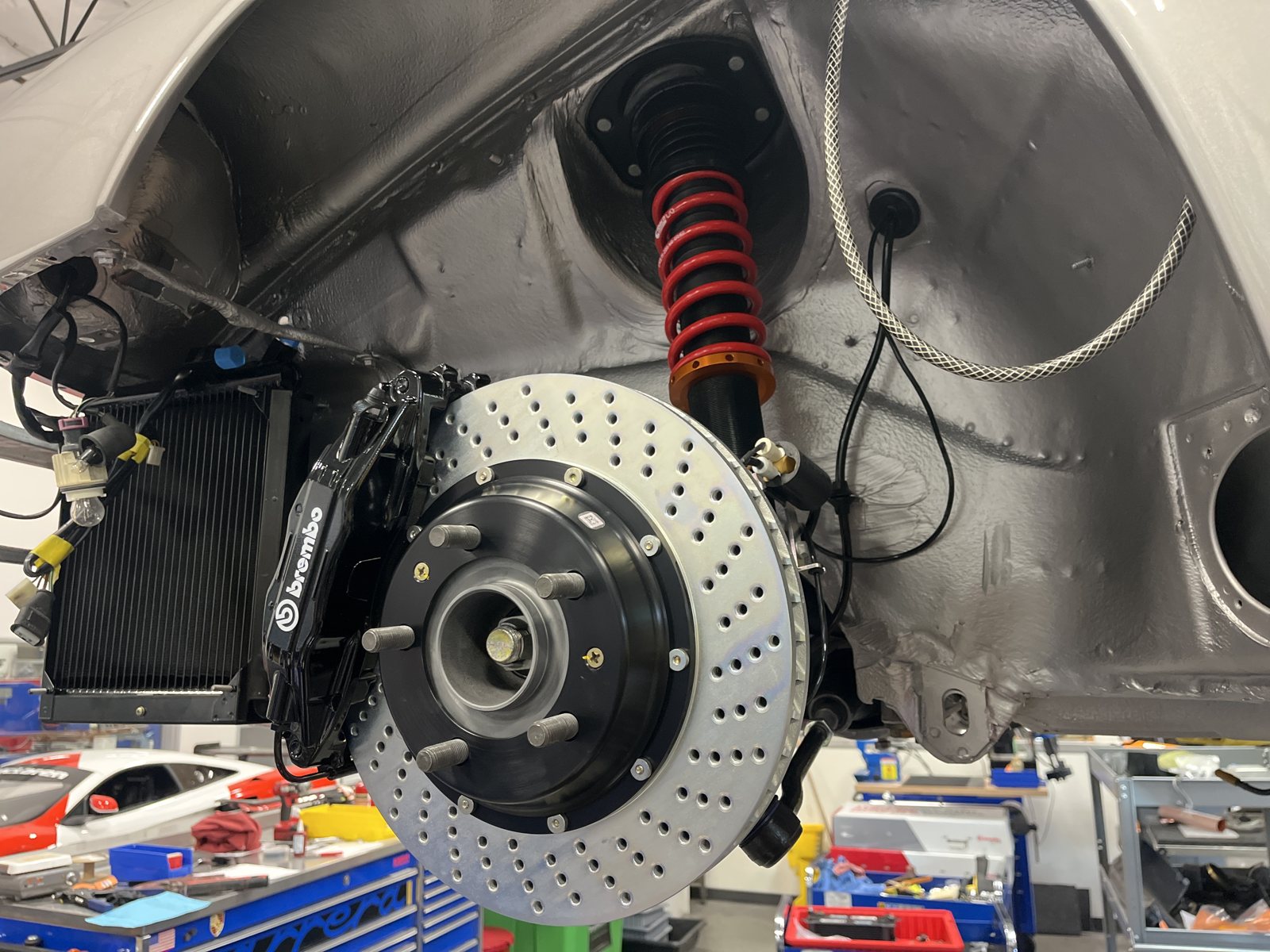
Porsche developed these uprights as the competition evolution of this front corner, and they exist for exactly this case: a lowered car. Lowering a 964 on stock uprights degrades the geometry three ways at once. The lower control arm angles upward, putting the suspension on the wrong part of its camber curve. The strut compresses, giving up travel and putting the bump stops into play. And the tie rod moves out of plane, so every bump steers the car — the driver corrects constantly without knowing why. The RS upright fixes all three in one part: the wheel bearing sits about 30mm higher relative to the ball joint, which restores the control-arm angle, the camber gain, and the suspension travel at the lowered height, while the relocated steering knuckle takes the bump steer out. Paired with the Tractive dampers, the geometry is correct before the electronics ever act. The set weighs 16.8 pounds in aluminum where the 964 originals were steel — 5 lbs saved per corner, 10 lbs total across the front axle, all of it unsprung. The caliper carriers and hardware the swap requires were purchased with it.
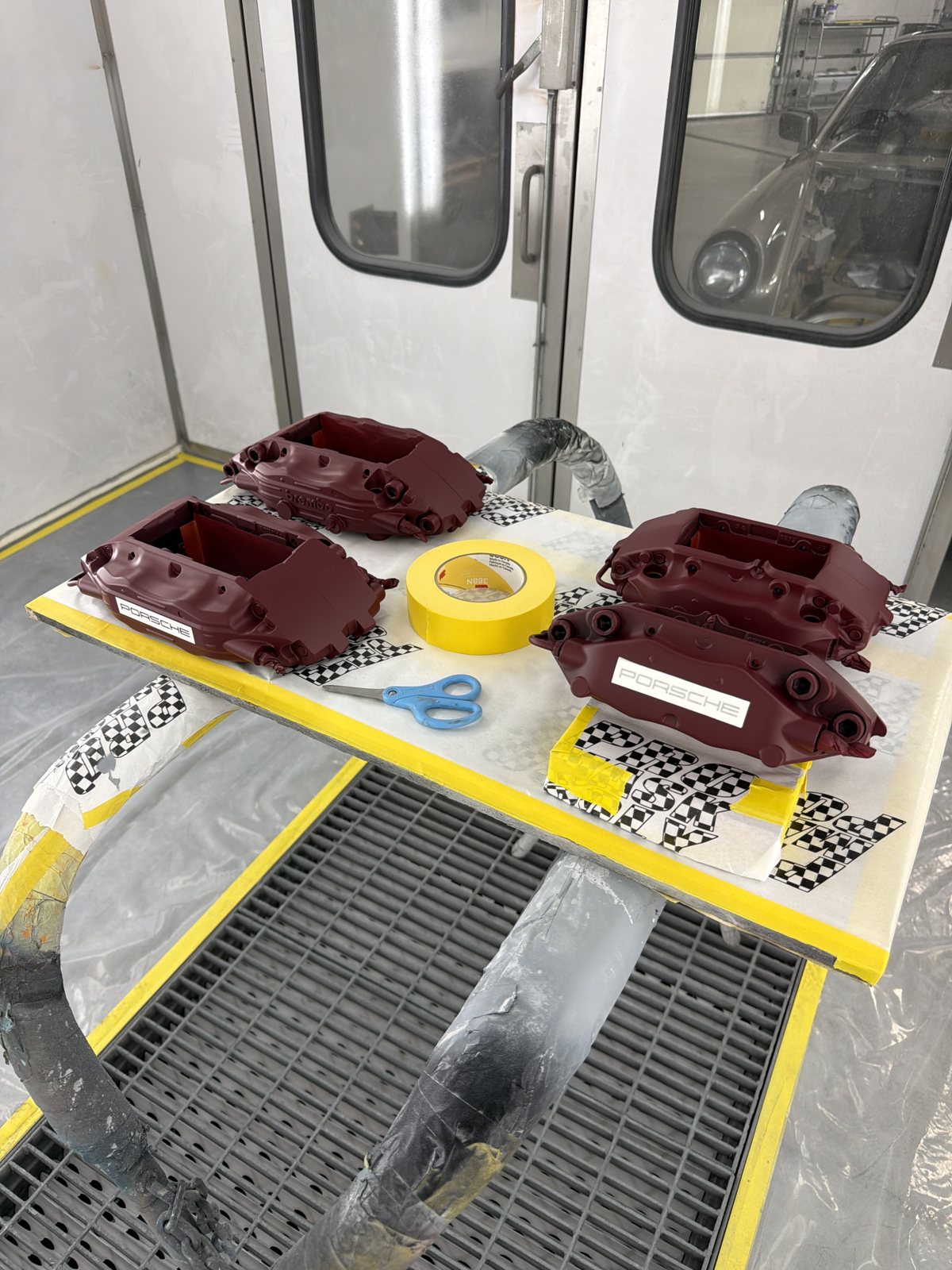
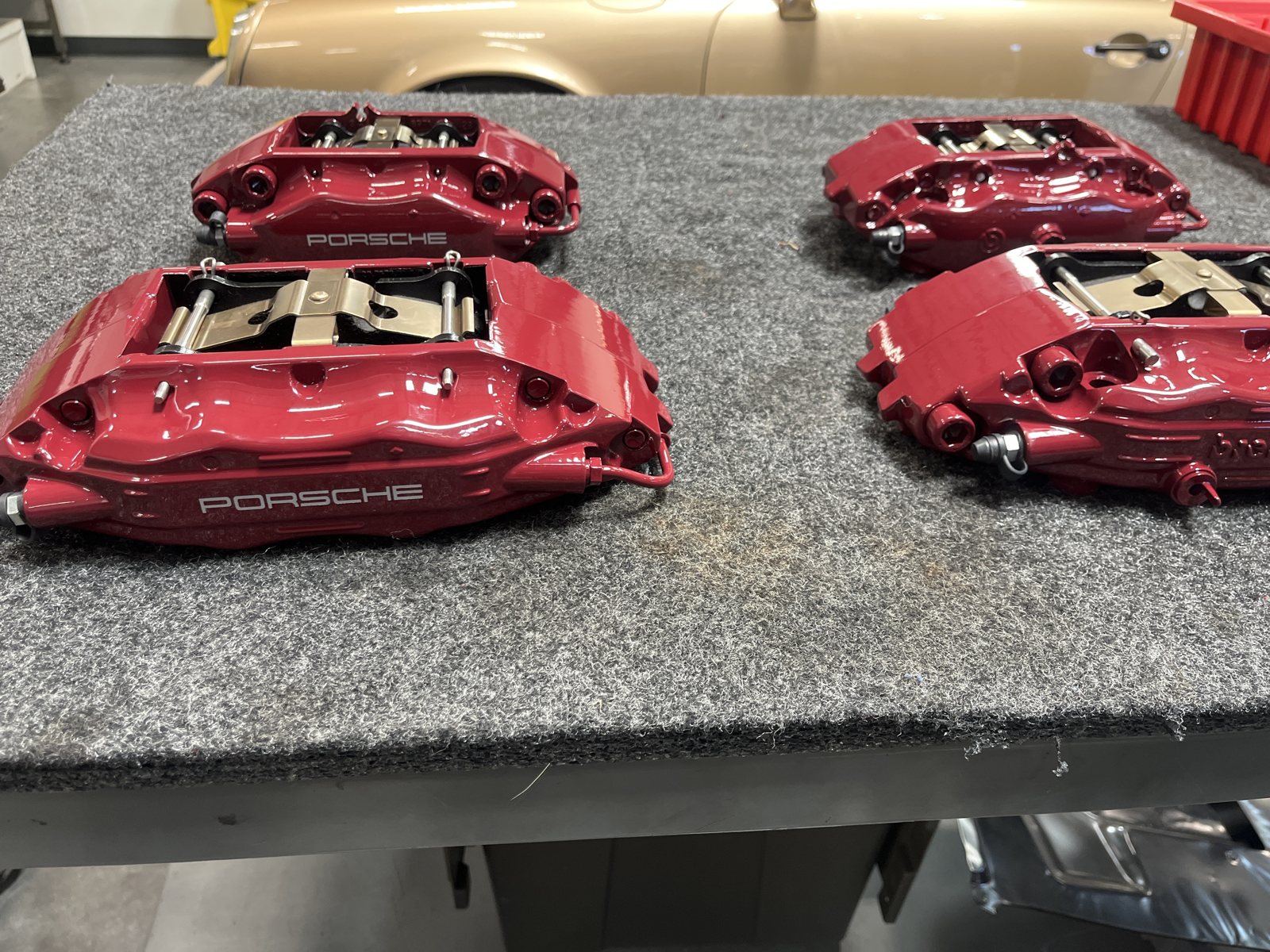
The common upgrade is the largest caliper that fits. This build selected the opposite: a modern Brembo GT system of the type specialists like Sharkwerks build these cars around. In its 17-inch-wheel configuration for the 964, that means 4-piston calipers on 332×32mm two-piece floating discs in front, 328mm behind. Two-piece discs carry an aluminum center hat, so the assembly weighs less than the one-piece iron it replaces while dissipating heat better; the caliper is stiffer and lighter than the factory casting. The custom kit — painted and Porsche-branded — reduces unsprung mass by roughly 15 lbs. And the whole package is sized inside the 17-inch envelope — the diameter family the car was designed around — where oversize kits force 18-inch wheels and give the weight advantage back as rotating mass.
The 993's six-speed G50 replaces the 964's five-speed. It is the direct factory evolution of this driveline. The shop built it up on the bench with a 3.154 RS/RSR first gear and spacing selected for the 4.0's torque curve, then sealed it once. Behind the engine, a Euro RS single-mass conversion replaces the factory 45 lb dual-mass flywheel, dropping roughly 19 lbs of rotating mass — the change a driver feels most directly from the seat, in how fast the engine gains and sheds revs. The shifter is a numeric short-throw unit. The gear selection was modeled before it was bought: the chart below shows where the revs land after each redline upshift, stock gearing against the selected set. The shorter first gear puts the 1–2 shift 660 rpm higher — into the meat of the powerband instead of below it — and the taller sixth pulls the final upshift down to a relaxed cruise.
Subtraction & Redistribution
Development also means removal — and relocation. The original 911 was designed with none of this equipment: no air conditioning, no power steering, no heavy battery bank. Those systems arrived over the decades, and most of them accumulated at the back of a car that already carried its engine behind the rear axle. That accretion is what made the 911 famously tail-heavy. This build attempts to combat this with engineering: the weight that does no work is removed, what remains moves forward, and the car returns to the balance its original design intended.
The sunroof carries a motor, a cassette, a double-skinned aperture, and a steel panel at the single highest point of the car. Deleting the assembly for a solid roof panel removes about 29 lbs — the figure the 911-specific delete-panel makers publish for this chassis — and every one of those pounds comes off the highest point of the car, which lowers the center of gravity. The roofline cleans up with it.
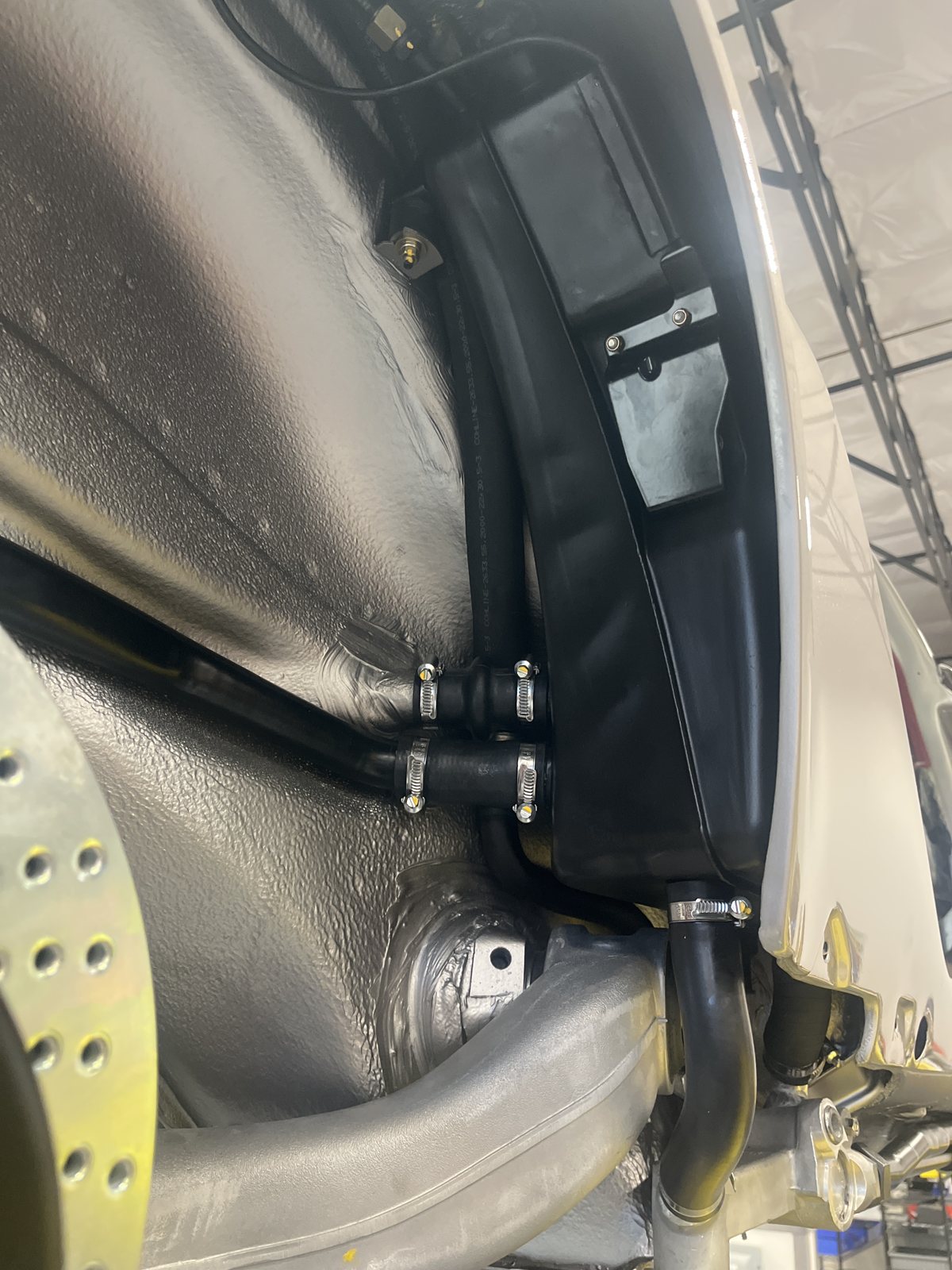
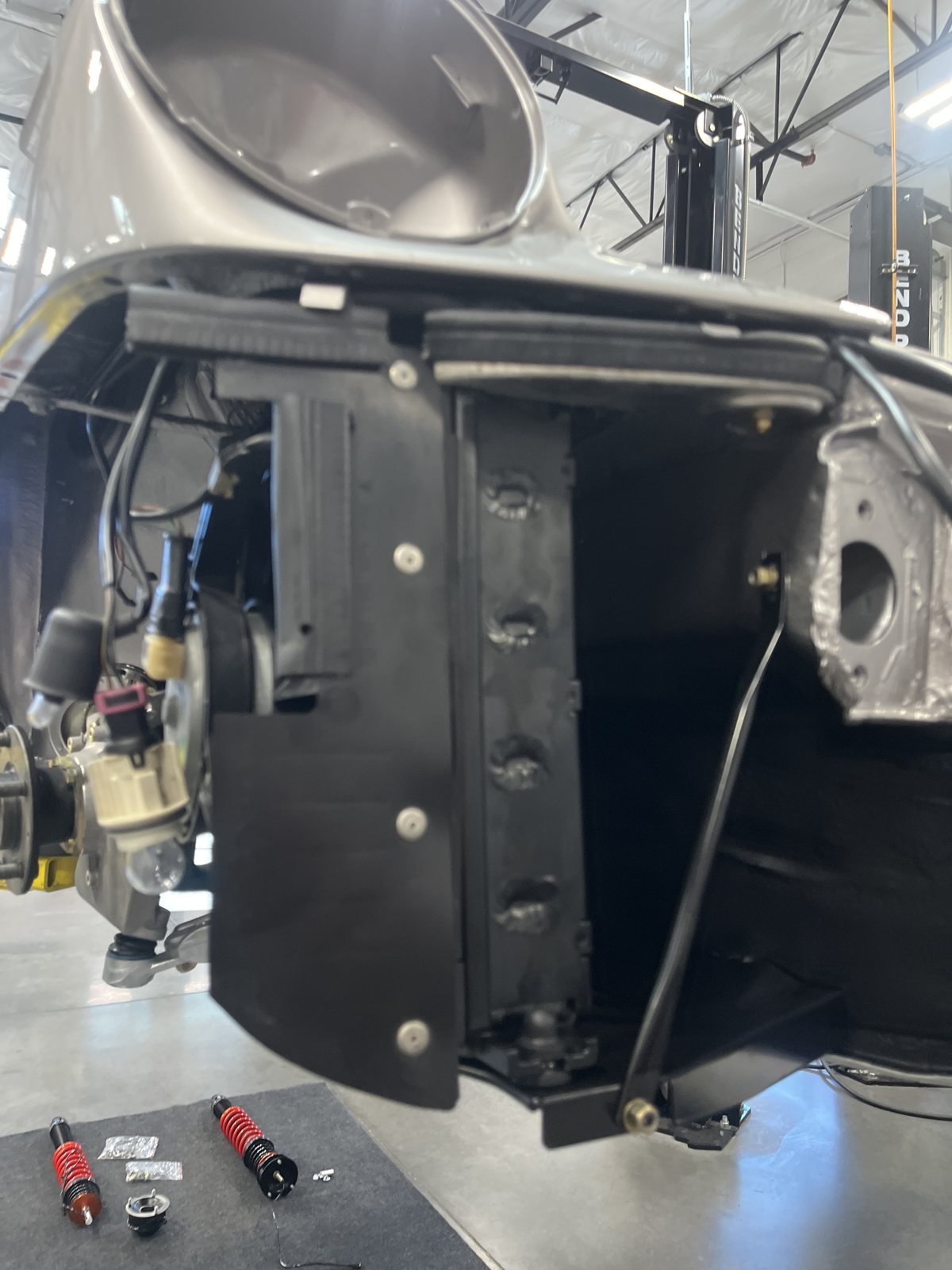
The stock system drove a compressor from the engine and routed heat from the exhaust. Classic Retrofit's electric 964/993 kit replaces everything but the blower unit: the complete system weighs around 22 lbs, with a narrow hose set under 4 lbs, and Classic Retrofit's own figures put the net saving on a factory-A/C car at roughly 40 lbs. Just as important is where the weight goes: every component fits in the front of the car — nothing at the rear — while the heavy belt-driven compressor comes off its elevated perch in the engine bay, off the crank (the electric pump draws under 1 hp), and out of the engine compartment entirely.
Lithium batteries replace the lead-acid unit and mount up front, saving 22 lbs. The power steering stays hydraulic — the feel is part of the car — but its pump moves to the nose, electrically driven off the front battery bank instead of belted to the engine. Shorter lines and no direct load on the motor: typical estimates put the total saving at 4–5 lbs, all of it either off the crank or off the rear. The Classic Retrofit climate system packages forward as well — no compressor on the belt. Taking these accessories off the crank does more than move weight: every pump and compressor the engine no longer drives is load and vibration removed from the rotating assembly, and the harmonic balance that buys is critical in a flat-six this large. Each system is lighter than the part it replaces, and each one shifts the balance toward the front. The chassis stayed essentially as conceived in 1963 while the creature comforts crept in — through the late F-body cars, the early G-bodies that were still close to them, the later G-bodies in a big way, and finally the 964 — and most of that mass landed at the back, adding to the pendulum the engine already made. This build rolls some of it back. Not to pay homage to history, but to restore the original engineering intent: the equipment the design never planned for now sits where it helps the car instead of where it happened to fit.
With the compressor, plumbing, and heat hardware removed, the bay was refinished in body color and rebuilt around the engine alone. The 24-valve engine is the only thing a viewer sees when the decklid opens.
Body & Color
The 964's shape is unchanged; the work finishes its details. The front bumper is smoothed, removing the seams and fittings the production line required. The mirrors are the aerodynamic units Porsche fitted to later 911s. New glass front and rear deletes the rear wiper — a cleaner tail and one more motor gone. The fog lights are deleted too, replaced by factory RS scoops that duct air to the brakes and the oil cooler. The engine lid is replaced with an OC Custom Parts carbon fiber ducktail — designed specifically to the 964's bodylines rather than grafted from an earlier car, so it pays homage to the 2.7 RS while sitting on this body the way the factory would have drawn it. It also saves nearly 17 lbs at the rear of the car, exactly where weight hurts most. Each change follows the factory's own direction.
The color is Sterling Mist Metallic — Sterlingscher Nebel — mixed in the BASF Diamont system. It was chosen from real sprayed panels, walked into the Arizona sun and judged there. The first color photos went to the owner in February; the approval took one look. The full refinish carried three coats of clear, wet-sanded to 3000 grit and polished. July's work order covered the detail phase: the spoiler disassembled, the decklid stripped and re-shot.
Wheels
The wheels are Fikse forged single-piece units in 18 inches, made in the Fuchs five-petal pattern. The design acknowledges the most recognizable wheel in Porsche's history; the forging, the size, and the fitment serve the car as built. They are also lighter than what they replace: owners who have made the same move from the cast Cup wheels to forged Fikse units report savings of 6.6 lbs per corner — just over 26 lbs in total — and the monoblock construction carries no joint hardware to add back — rotating and unsprung mass removed even while the diameter grows. The tires are modern Michelin Pilot Sport 5s: a contemporary compound and construction giving the chassis grip and wet manners no tire of the car's era could. The centers are Cerakoted in a custom color developed against a painted Sterling Mist sample panel; approval came against the panel, and James's color-match photo is part of the record.
Interior
The interior is the largest phase still ahead, and the most fully designed. Its plan lives in the owner's inspiration deck, and its parts are already arriving.
The whole cabin works from a single leather: Spinneybeck Amalfi. Smooth panels cover the seat sides and headrests. The seat centers carry a hand-woven 5mm strip weave, alternating inside and outside faces — a weave developed for this project and made once, for this car. A double-stitched treatment carries the upper dash.
The 964's own seat silhouette, rebuilt in modern materials by the shop whose seats run in competition 911s. Designed with Callum for the Tuthill 911K, each carbon fibre frame weighs just 9.9 lbs — 19.8 lbs for the pair, saving 61 lbs against the power-adjustable factory seats. The seat is fully crash-tested by UTAC and has passed all TÜV standard tests. The carbon shells match the cabin's other carbon elements: door cards, console, trim. An earlier carbon-shell direction was ordered, then set aside when these became available; it sits in the superseded ledger and remains the owner's property. Speaker clearance gets measured before the leather is cut.
Raw carbon set deliberately against soft leather — accents that highlight the purposeful nature of the build without distracting from it. The CarBone door cards carry metal switch frames; the Monomod console anchors the tunnel. Stuttgart Classica supplies the supporting trim: instrument panel, door handles, ignition rosette, vents, and sills.
The gauge faces will stay analogue, with the tachometer color matched to the Amalfi leather and one readout added for the Tractive system. The headliner is already sewn. The Classic Performance steering wheel cleared customs in May.
Where It Started, Where It Lands
The car arrived as Porsche built it: roughly 3,031 lbs at the curb, 247 horsepower at the crank, a redline of 6,720 rpm, and 12.3 lbs for every horsepower.
The documented reductions in this binder are estimated to be more than 300 lbs, and where they come from matters as much as the sum. Roughly 50 lbs is unsprung — uprights, brakes, and wheels, the weight the suspension must control on every bump. Roughly 100 lbs comes off the rear of the car — the exhaust, the ducktail, the flywheel, the heads and rotating assembly, and the compressor pulled from the engine bay. And of the systems that remain, roughly 45 lbs now rides ahead of the front axle — the lithium batteries, the electric climate hardware, and the relocated power-steering pump — moved rather than merely replaced. The finished car should settle near 2,700 lbs, sitting lower on RS-corrected geometry with its balance moved forward.
Power moves the other direction. Comparable 24-valve four-liter engines produce on the order of 430 horsepower, and this one will chase that figure at a redline of 8,500 to 9,000 rpm, set on the dyno. Taken together: roughly 6.3 lbs per horsepower, against the 12.3 the car was born with. For reference, the 997 GT3 RS 4.0 — the last Mezger, and this engine's closest factory relative — carried about 6.0 lbs per horsepower at roughly 3,000 lbs and 500 hp. This car will sit within reach of that figure, in the original 964 body.
For scale: Porsche removed 345 lbs to make the 964 RS, and gave up the air conditioning, the sound deadening, and the rear seats to do it. This build removes nearly as much while adding better air conditioning, adaptive damping, and a sixth gear.